Tag: Publications

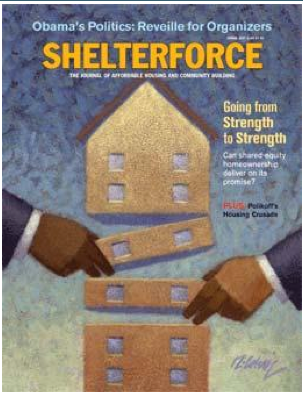
  • Shelterforce: Best of Both Worlds

    Shelterforce: Best of Both Worlds


    Permanent affordability and asset building might seem at first blush to be contradictory goals for a low-income homeownership program, but new research says in fact they can be achieved together. By Rick Jacobus

    In the mid 1990s, the homeownership rate began to rise for the first time in decades. Social equity advocates were encouraged by the fact that, also for the first time, it appeared that ownership for lower income buyers and buyers of color was rising even faster. Policymakers in Washington cheered the fact that this change seemed to come from private mortgage market innovation rather than increased federal spending.

    Looking back, this all seems like a dream—or rather a nightmare. Rather than opening a door to economic opportunity for disadvantaged families, “innovative” mortgage products led to financial ruin for families and for our whole economy.

    The foreclosure crisis has led some policymakers to call for abandoning the goal of expanding access to homeownership. Certainly ownership has been oversold, and the current crisis demands a rethinking of housing policy including greater investment in affordable rental housing. But persistent and still-growing asset inequality (itself largely a product of discrimination in earlier generations of housing policy) remains a problem with very significant consequences, one that is unlikely to go away on its own. Any serious effort to overcome persistent asset inequality will require renewed efforts to overcome barriers to homeownership.

    Luckily, relaxing credit standards is not the only strategy for expanding access to homeownership. Decades of experimentation in state and local programs have shown that it is possible to invest in homeownership in smarter and more sustainable ways. A new research report from the Urban Institute suggests that local programs that provide significant purchase assistance to low-income buyers while preserving long-term affordability can offer a sustainable and scalable strategy for overcoming generational asset inequality.

    Homeownership and the Asset Gap

    Social policy in the United States has long focused on income-based measures of poverty and inequality. Since the late 1980s, however, there has been a growing attention to asset poverty and asset inequality and over the past few decades assets have been distributed more unevenly than income, and asset disparities have grown wider. According to a 2003 Census Bureau report, the average African-American family has net assets of only $9,750 while the average white family has $79,400.

    Most of this difference is home equity. The average homeowner has net assets of $235,000 while the average renter has only $5,000.

    This persistent and growing asset inequality is both a result and an ongoing cause of widespread inequality in access to homeownership. During the period following WWII, when federal programs made homeownership possible for the great majority of American families, these same programs were actively promoting racial discrimination in the housing market. By the mid 1960s, when overcoming discrimination became a key federal housing goal, federal programs were, ironically, no longer contributing to rising homeownership rates. The homeownership gap between white and minority households has not changed in decades and is projected to be higher in 2010 than it was in 1910.

    This historical ownership gap today drives continued inequality in access to homeownership—and by extension continued asset inequality. Renters who want to buy homes face multiple barriers including credit barriers, income barriers, and asset barriers. But recent studies have shown that asset barriers are the most widespread.

    Many young families overcome a lack of savings through gifts or loans from their parents or other family members. One-third of white first-time homebuyers receive financial support from a family member, but only 6 percent of African-American buyers receive family assistance, and those who do receive much lower levels of assistance. Families that didn’t benefit from asset appreciation through homeownership in prior generations therefore find that they are unable help the next generation access homeownership today. The high cost of housing and lack of family assets have largely taken the place of overt discrimination in preventing minority families from buying homes today—but the result is just the same.

    Overcoming the Wealth Barrier

    And yet, we do know how to overcome these barriers and make ownership safe and affordable for lower income families.

    A 2009 report by the U.S. Census Bureau estimated that 7 percent of current renters could safely afford to buy homes using standard mortgage products. They found that subsidizing mortgage rates by as much as 3 percentage points had virtually no effect on the number of renter families that could afford ownership and that offering loans with no downpayment requirements would increase that number by only 2 percentage points (to 9 percent). Providing purchase subsidies, on the other hand, had a more dramatic result. A subsidy of $10,000 (whether from a family member or a public program) would increase the number of renters who could qualify for ownership by 12 percentage points (to 19 percent).

    In light of this research, it is surprising to note that while we spend billions of dollars annually on programs to expand homeownership, only a very small fraction is currently invested in purchase subsidy programs. This is so even though purchase subsidies are currently the dominant strategy for supporting affordable rental housing.

    Programs that provide purchase assistance to bring the costs of homeownership down to an affordable level not only make ownership possible for lower-income buyers, they make it safer and more sustainable. Instead of borrowing more than they can afford to repay, qualified buyers borrow what their incomes can support, with the gap being covered not by a relative, but by a public or nonprofit agency.

    Many believe, however, that these programs are simply too expensive to offer a realistic alternative to mortgage product innovation as a path to expanded homeownership.

    A growing number of affordable homeownership programs address this concern by preserving long-term affordability so that a one-time public investment can make homeownership possible for one lower income family after another. These programs offer targeted assistance to buyers who would not be able to buy without such help and they preserve the affordability of assisted units so that many more households can ultimately benefit from the same initial investment. The growing stock of affordable homes in these programs offers a sustainable way to grow the overall rate of low-income and minority homeownership.

    These programs achieve this result by limiting the level of price appreciation available to owners. In exchange for significant public support at the time of purchase, they require owners to pass that benefit along to future lower income buyers by reselling at an affordable price or repaying the subsidy along with a share of any market price appreciation. Participating homeowners do build assets, but in an expanding market they earn less than unrestricted market-rate homeowners.

    Critics of this approach understandably question whether limiting a lower income buyer’s potential price appreciation defeats one of the key purposes of homeownership. If appreciation is limited, can affordable homeownership still offer a path out of generational asset poverty? If assisted homeowners can’t earn the same home equity gains that other owners enjoy, won’t they be trapped in affordable homes?

    Policymakers face what sometimes seems like a no-win decision: either they make grants that offer wealth-building but only to a lucky few or they preserve affordability but sacrifice the goal of reducing asset inequality.

    New Research

    Though many working in programs that balance both goals have long said this was a false choice, for the first time, there is real data that shows that long term affordability and significant asset-building can go hand in hand.

    NCB Capital Impact commissioned the Urban Institute to rigorously evaluate measurable outcomes for seven affordable homeownership programs that attempt to preserve long-term affordability. The Urban team analyzed data on home sales and subsequent resales through 2008 from three community land trusts, two limited-equity cooperatives, and two deed-restricted affordable housing programs.

    Each of the programs in the Urban study imposes some form of price restriction designed to keep homes affordable. And yet, these programs nonetheless had strong asset-building outcomes at the same time.

    Homeowners in these programs sold their homes after an average of three to six years. Their average total proceeds from sale ranged from $6,277 for a limited equity cooperative in Atlanta to $70,495 for owners in San Francisco’s Inclusionary Homeownership Program. In spite of the limitations, sellers received average appreciation ranging from $2,015 to $42,524.

    Because, for the most part, homeowners made small initial investments, this appreciation tended to represent a very high annual return on investment. For example, in Boulder, Colo., the average Thistle CLT homebuyer invested $6,080 in downpayment and closing costs at purchase. The Boulder sellers moved after an average of 3.4 years and earned an average of $8,107 in appreciation. These buyers earned the equivalent of 22 percent annual interest on the money that they invested to buy their affordable homes (“internal rate of return”). In the programs in the Urban study, participants’ internal rates of return ranged from 6.5 percent to 59.6 percent. In all but one case, they built more equity than they would have if they had placed their downpayment in an S&P 500 index fund or a 10-year Treasury Bond.

    But was it enough? The modest level of asset-building that these programs offer was enough to support sustained homeownership and to give households who originally couldn’t access the wider housing market the means to move on to buy a market-rate home.

    As part of their research, the Urban Institute surveyed households that had sold affordable homes in one of the programs. In the four programs that participated in the questionnaire, a significant majority of sellers went on to buy owner-occupied

    market-rate housing without any further public subsidy. Boulder had the highest rate, with 78 percent of sellers using their affordable unit as a stepping-stone to market-rate homeownership.

    The annual turnover rate for the programs studied was comparable to national rates for all owners, dispatching concerns that participants would be locked into their properties.

    Although assisted homeowners generally accumulated less home equity than buyers of unrestricted, market-rate homes, they also had significantly less risk. They were less likely to experience foreclosure than the average homebuyer—even though their average incomes are much lower (See Stewardship Works, SF #163). And they managed to sustain homeownership at a far higher rate. Several studies have found that roughly half of all low-income, first-time homebuyers revert to rental housing within five years. By contrast, fully 91 to 95 percent of homeowners in this study remained owners five years later, either continuing to occupy their affordable home or having acquired a market-rate home.

    During a time when the housing market fluctuated drastically, the prices in all seven of these programs were remarkably stable, as were the income groups that could afford them. The result was that, because the homes remained affordable, the programs could offer safe and sustainable ownership and asset-building opportunities to a second, third, or fourth generation of buyers, generally without investing any further public subsidy. The Urban study found, for example, that the City of San Francisco was saving roughly $25 million annually by preserving affordability rather than having to introduce a new subsidy each time these homes were resold.

    Affordable Ownership as an Asset-Building Strategy

    Because these affordable homeownership programs can help families build wealth faster than investing in stocks or bonds with less risk than traditional homeownership, they offer a promising strategy for overcoming asset inequality. Much of the attention in asset-building policy has focused on individual development accounts (IDAs), which provide matched savings as an incentive to help lower income families build assets. While IDA programs generally serve a slightly lower income population, and they offer a way to save for important goals other than homeownership (including education and small businesses), they are often promoted as offering a path to homeownership for low-income participants. And yet most IDA participants are unable to save enough to access homeownership. Most IDA programs limit savings to $6,000 to $10,000 and the average IDA saver accumulates only $1,500. By comparison, affordable homeownership programs, even those with long-term affordability controls, seem of offer a more reliable way for low-income families to save enough to make traditional homeownership safely attainable.

    Contrary to what many have thought, we do not have to choose between affordability and asset building. We can do both. By offering real equity to families who would otherwise remain renters, and providing a safer vehicle for them to attain—and retain—homeownership, affordable homeownership programs can provide a predictable avenue for asset building and economic advancement.
  • A Path to Homeownership

    A Path to Homeownership

    Building a More Sustainable Strategy for Expanding Homeownership

    A Path to Homeownership
    A Path to Homeownership

    Download PDF File
    Homeownership continues to provide real social and economic benefits and remains a high priority for most American families, but the United States is experiencing significant declines in the ownership rate for the first time in decades. What we need is greater availability of targeted purchase assistance programs that address wealth barriers to homeownership.


    Event Video:

    For more about this event, visit the Center for American Progress.

  • Brookings: Retail Trade as a Path to Neighborhood Revitalization

    Brookings: Retail Trade as a Path to Neighborhood Revitalization

    Contact About Resources Portfolio Home

    Picture 5.png

    Buy the book on Amazon.com
    Download the chapter: Retail Trade as a Path to Neighborhood Revitalization by Karen Chapple and Rick Jacobus

    Picture 10.png

    A condensed version of the chapter was also produced by UC Berkeley’s Center for Community Innovation.

    From the introduction:
    “Retail trade is a highly visible feature in a community, and is often a symbol of economic status. Terms like “upscale retail,” “strip mall,” or “big box store,” convey very different images of retail trade that are widely associated with economic prosperity, or the lack thereof. But, does retail trade really revitalize run down or neglected neighborhoods? And if so, what are the mechanisms at work, the successful strategies, and necessary conditions that lead to success? In “Retail Trade as a Route to Neighborhood Revitalization,” Karen Chapple and Rick Jacobus tackle these questions. They begin by defining the issues and expectations associated with retail development and neighborhood revitalization. The authors state that, from the perspective of residents, there are three types of neighborhood revitalization: more access to services and opportunities for low-income populations; changes from a low-income neighborhood to a mixed income neighborhood (due either to an influx of newcomers or increases in incomes for local residents); and gentrification that gradually replaces existing low-income residents with more affluent newcomers. Using a conceptual model, Chapple and Jacobus describe the relationship between retail development and neighborhood revitalization.

    Their review of the literature finds mixed evidence for the assumption that low-income neighborhoods are underserved, and limited formal evaluation of the effects of retail development, especially with respect to overall neighborhood improvement. The authors acknowledge the challenges to evaluating retail development programs, such as their small scale, the variety of actors involved, and limited neighborhood level capacity. In reviewing the evidence, Chapple and Jacobus examine three broad strategies to retail revitalization: public-led retail development, private-led retail development, and commercial corridor revitalization. Retail strategies variously target job creation, vacancy rates, private investment, public investment, tax revenues and property values, crime and safety, and community identity. In order to further explore the relationship between these retail development goals and neighborhood revitalization, Chapple and Jacobus provide a case study of the San Francisco Bay Area, analyzing the relationship between retail and neighborhood revitalization from 1990 to 2005 in a region with unusual increases in income inequality accompanied by significant revitalization. They find that the way the retail sector changes is closely related to how the neighborhood changes, with increases in middle income residents (rather than gentrification or other forms of change) most closely associated with retail revitalization.

    The paper concludes with the suggestion that any large-scale impacts of retail development on community economic health occur indirectly, such as through changes in internal and external perceptions of the neighborhood and, ultimately, changes in neighborhood residential composition. But, the authors note that existing studies of the effectiveness of neighborhood retail development strategies have not explored these broader impacts. Chapple and Jacobus also recommend further research to address how outcomes for the poor are tied to the specific character of neighborhood change. Such research might suggest specific retail development strategies that are most likely to benefit the poor and lead to stable mixed-income communities without contributing to displacement of the poor.”

  • The Asset Building Potential of Shared Equity Homeownership

    The Asset Building Potential of Shared Equity Homeownership

    Picture 6.png
    Download PDF

    In this paper for the New America Foundation, we review the literature on homeownership as an asset building strategy for lower income households. We then present a real world case study, examining wealth building and household mobility among buyers of 424 resale-restricted, owner-occupied houses and condominiums developed by the Champlain Housing Trust (CHT) in Burlington, Vermont between 1988 and 2008. We conclude by comparing the asset building potential of shared equity homeownership to the rewards and risks associated with other strategies for helping lower income families to accumulate assets and build wealth.

  • The City-CLT partnership

    The City-CLT partnership

    Municipal Support for Community Land Trusts

    Published by the Lincoln Institute for Land Policy

    By John E. Davis and Rick Jacobus

    Download PDF File

    Based on interviews with dozens of practitioners from around the country, this guidebook is intended to help local government policymakers to develop stronger partnerships with local Community Land Trusts to develop and monitor permanently affordable homeownership units.


    Two companion documents were also produced:

    City-CLT Partnerships in Search of Best Practices

    City-CLT Regulatory Agreements


    Publisher’s Abstract:

    The community land trust (CLT) movement is young but expanding rapidly. Nearly 20 community land trusts are started every year as either new nonprofits or as programs or subsidiaries of existing organizations. Fueling this proliferation is a dramatic increase in local government investment and involvement. Over the past decade, a growing number of cities and counties have chosen not only to support existing CLTs, but also to start new ones, actively guiding urban development and sponsoring affordable housing initiatives.

    Two key policy needs are driving increased city and county interest in CLTs, particularly in jurisdictions that put a social priority on promoting homeownership for lower-income families and a fiscal priority on protecting the public’s investment in affordable housing.

    • Long-term preservation of housing subsidies. With local governments now assuming greater responsibility for creating affordable housing, policy makers must find ways to ensure that their investments have a sustained impact. CLT ownership of the land, along with durable affordability controls over the resale of any housing built on that land, ensures that municipally subsidized homes remain available for lower-income homebuyers for generations to come.

    • Long-term stewardship of housing. Preserving housing affordability requires long-term monitoring and enforcement, an administrative burden that local governments are neither equipped for nor generally interested in taking on. CLTs are well positioned to play this stewardship role by administering the municipality’s eligibility, affordability, and occupancy controls, while also “backstopping” lower-income owners to protect subsidized homes against loss through deferred maintenance or mortgage foreclosure.

    Municipal support comes in a variety of forms, depending on how well established the CLT is. For example, local governments may offer administrative or financial support during the planning and startup phase, followed by donations of city-owned land and grants or low-interest loans for developing and financing projects. They may help a CLT acquire and preserve housing provided by private developers to comply with inclusionary zoning, density bonuses, and other mandates or concessions. As the CLT builds its portfolio, municipalities may provide capacity grants to help support its operations. Finally, local jurisdictions may assist CLTs by revising their tax assessment practices to ensure fair treatment of resale-restricted homes built on their lands.

    As welcome as their support has been, local governments may inadvertently structure CLT funding and oversight in ways that undermine the effectiveness of the very model they are attempting to support. The challenge lies in finding the most constructive ways of putting municipal resources to work in pursuit of common objectives.

    Based on a review of three dozen municipal programs and in-depth interviews with local officials and CLT practitioners, this report describes the mechanisms and methods that cities across the country are using to structure their investment in CLT startups, projects, and operations. In addition to describing the full range of options for providing municipal support, the report highlights specific model practices for rendering that assistance. These practices have the most potential to balance the interests of all parties by:
    • protecting the public’s investment in affordable housing;
    • expanding and preserving access to homeownership for households excluded from the market;
    • stabilizing neighborhoods buffeted by cycles of disinvestment or reinvestment; and
    • ensuring accountability to funders, taxpayers, and the communities served by the CLT.

    The city–CLT relationship continues to evolve. This report ends with a discussion of three emerging trends: shifts in the city’s role from supporter to instigator, and from participant to governor; and a deepening of the CLT’s primary role as a steward of affordable housing created with municipal assistance. While posing new challenges, these changes also present new opportunities for tomorrow’s city–CLT partnerships

  • Best Practices in Inclusionary Housing

    Best Practices in Inclusionary Housing

    Delivering on the Promise of Inclusionary Housing:
    Best Practices in Administration and Oversight
    By Rick Jacobus for PolicyLink

    This paper outlines some of the challenges of ongoing administration of Inclusionary housing programs and highlights the policies, procedures and systems that successful programs have been using to address these challenges. The paper identifies common approaches to staffing these programs over time including partnerships with local consultants or nonprofit organizations and looks at scalable revenue sources to support the ongoing costs of administration.

    Click here to download the PDF File (2MB).

  • Stewardship for Lasting Affordability

    Stewardship for Lasting Affordability

    Administration and Monitoring of Shared Equity Homeownership

    By Rick Jacobus

    For NCB Capital Impact and NeighborWorks America

    November 2007

    The shared equity approach requires local servicing for long term success. Services include preparing new qualified homebuyers, assisting in refinancing, supporting home improvements, foreclosure prevention, and re-sales. How can these functions be supported through scalable fees? What impact does this have on the affordability and definition of the target market after factoring in full cost? What implications does this have for financing? For local policy?

  • Grocery Store Attraction Strategies

    Grocery Store Attraction Strategies

    Grocery Store Attracton StrategiesA Resource Guide for Community Activists and Local Governments

    By Rick Jacobus and Maureen Hickey

    Download PDF File

    This report was commissioned by Bay Area LISC and PolicyLink with sponsorship from the California Endowment, LISC’s Commercial Markets Advisory Service, State Farm Insurance, and CitiBank.  The report provides an overview of the process that community activists have used to attract new fresh food retailers into disinvested urban communities.


  • Economic Development and Health Toolkit

    Economic Development and Health Toolkit

    Economic Development for Public Health Advocates

    PHI Web_med.png

    Now Online at ChangeLab Solutions

    Download PDF File

    This toolkit developed for the Public Health Institute’s Land Use and Health Program is designed to provide an overview of Economic Development and Redevelopment issues for health advocates seeking new food stores in low income communities.

    TABLE OF CONTENTS:
    Section I: Introduction to Economic Development, Redevelopment, and Health

    1. Introduction to this Toolkit
    2. The Connection Between Economic Development and Health
    3. Why Do So Many Communities Lack Access to Healthy Food?
    4. Developing a Strategy

    Section II: Economic Development

    5. What is Community Economic Development?
    6. Types of Community Economic Development Programs
    7. Economic Development Institutions
    8. Financing Sources

    Section III: Redevelopment

    9. Overview of Redevelopment Law
    10. Legal Requirements for Redevelopment
    11. Introduction to Tax Increment Financing
    12. Introduction to Eminent Domain
    13. Support for Economic Development Projects
    14. Final Points

    Section IV: Strategies for Participation

    15. Building Community Support
    16. Data Collection
    17. Model Redevelopment Resolution
    18. Communicating with Public Officials

    Section V: Appendices

    Appendix 1: Sample Market Research Consultant Request for Proposals
    Appendix 2: Redevelopment Agency Model Resolution
    Appendix 3: Resources