Author: Rick Jacobus

  • Pay for Success: Overcoming Information Asymmetry

    Pay for Success: Overcoming Information Asymmetry

    June 2, 2014   |  by Rick Jacobus, Director of Strategy and F.B. Heron Foundation Joint Practice Fellow at CoopMetrics

    If you read much of the recent flurry of writing about Pay for Success, you will notice a regular pattern where authors acknowledge that widespread implementation will require “better data” and then quickly change the subject. Surely better data is on the way. We live in an age where it is easy to take this kind of inexorable progress for granted, but given the level of enthusiasm for Pay for Success, it is worth considering what it will realistically cost to get good enough data.

    Certainly the whole potential of Pay for Success rests on data. In order to offer strong financial incentives for success, a government agency must be able to know that their private partner has succeeded. And measuring the “success” of a social program is notoriously hard. We all know it when we see it, but it is not simple to write out a clear and unchanging definition for any given program. A youth employment program cannot simply be judged by the number of youth who get jobs—we need to say something about the quality of those jobs, the level of challenge facing the youth who enter the program, the local economy’s strength, etc.

    This is an example of what economists call information asymmetry. George Akerlof, who won the Nobel Prize for his work on information asymmetry, wrote a paper in 1970 about the market for used cars. Some used cars are in great shape and others are what Dr. Akerlof called “lemons:” they look fine but have been poorly maintained or have other hidden problems. Sellers know which kind of car they have, but buyers cannot immediately tell which is which. Sellers of above-average cars generally have to settle for average price, and buyers have to risk paying average price for a below-average car. A key point is that buyers can partially overcome this asymmetry by investing in information about a potential car; they can hire a mechanic to examine it. But there is also a limit—a simple inspection might weed out the worst cars, but the difference in value between an average and an above-average car may not be enough to justify a more complete inspection.

    Information asymmetry has historically been one reason that we have created nonprofit organizations. Take childcare: A childcare provider knows whether they are providing quality care or not, but it is difficult for parents to tell the difference. It would be very easy for an unscrupulous operator to boost profits by cutting important corners. It is not that they have more incentive to cut corners than someone who makes toothpaste, but because the parents who pay are not the day-to-day users of the service, it is easier to hide the cost-cutting. Organizing a child care center as a not-for-profit organization does not overcome the information asymmetry, but it does accommodate it by reassuring parents that at least the center does not have any incentive to provide low-quality care.

    Like parents, philanthropic donors are not present daily to see whether an organization is doing everything it can to make the most difference. Instead, they have to settle for knowing that the groups to which they give are trying to make a difference and do not have a profit motive to cut corners. The downside of this approach is that donors, like used car buyers, may sometimes have to accept average performance.

    Rather than accommodating information asymmetry, Pay for Success tries to overcome it. This is like pushing water uphill—it can be done, but you have to invest energy to do it. The very idea of Pay for Success requires a significant investment in information. In place of a government agency directly funding a social service agency and accepting average performance, a social impact bond (SIB) requires several layers of intermediaries and generally two levels of professional evaluation: an evaluator who works directly with the program to measure impact and an independent assessor who reviews the data on behalf of the government agency.

    McKinsey & Company developed a proforma to analyze the financial benefits of a hypothetical SIB focused on juvenile justice [1]. They found that even if an SIB-backed intervention produced significant savings for government agencies, the SIB structure was far more costly than directly funding the same services. In their model, a $14.4 million direct investment in preventive services would save the government $14.4 million in corrections costs over a period of about eight years. A successful SIB that funded the same $14.4 million program would incur an additional $5.7 million in research and administrative costs, success fees, and investor profits, and McKinsey & Company estimates that it would therefore take 12 rather than eight years before the public savings justified the increased cost.

    This extra cost sets the bar pretty high for the performance gains that the SIB must deliver. Information technology improvements will continue to make investment to overcome information asymmetry practical in more and more situations, but when the cost of collecting data is taken into account, the social problems that lend themselves to an SIB will be harder to find than they would be if perfect information were free. Once we have found them all, there will still be many important social problems that are worthy of public investment.

    If we want to confront some of our most complex social challenges, we have to come to terms with the reality that a significant level of information asymmetry is a fact of life and we cannot wish it away by calling for better data. For some social problems, sizable investment in information may make it practical to offer financial incentives to the best-performing programs. For the rest, we do not have to give up on using data to drive improved performance, but sometimes it might be more cost-effective to focus on raising the performance of the average program instead of providing financial incentives for above-average performance.


    [1] McKinsey & Company. (2012). From potential to action: Bringing social impact bonds to the US. Retrieved from http://www.rockefellerfoundation.org/news/publications/from-potential-action-bringing-social

  • Salesforce Foundation: 3 ways to make the case for Tech Funding

    Salesforce Foundation: 3 ways to make the case for Tech Funding

    From the Salesforce.com Foundation Blog

    For profit businesses are routinely able to raise significant capital in the expectation that a new technology will create higher profits over the long term. Nonprofits, by definition, can’t make this same promise and, therefore, find it much harder to raise the kind of money necessary to invest in transformative technology.

    But the technology itself holds the same promise to totally transform everything that nonprofits do – it is just taking us much longer to realize that promise. We know how to sell donors on delivering services and even changing policy but we have always had a harder time convincing people to fund institutional capacity and technology is essentially a new kind of organizational capacity that is now competing with everything else for scarce resources.

    When we are raising money for tech, we need to make the case that the investment will pay for itself in one of three ways: either by lowering costs, by raising revenue or by increasing our social impact.  Sometimes, our projects will offer all three benefits.

    1. Lower Costs

    In many ways, nonprofits are no different from other businesses: many technology investments will simply allow us to do what we do for less money over time.  While this increased efficiency can make organizations more sustainable, this category may be the hardest to get donors excited about because it may not directly translate to observable differences in our services.

    Making the case for this kind of investment involves calculating a payback period – the period of time over which an investment in technology will pay for itself. Be careful not to assume that these savings last forever, though.  Every technology has a useful life and more innovative technologies often become outdated quickly.

    2. Increase Revenue

    Technology that helps organizations build stronger connections or more effectively communicate with their donors can drive real increases in fundraising.  Similarly, technology that helps organizations do a better job of capturing the social impact that they are having (whether through formal measurement and statistical metrics or simply human stories) can increase revenues enough to easily justify their costs.

    Making the case for this kind of investment is also just a matter of calculating the payback period but now this is much harder to do because it is harder to predict the impact on revenue. So instead, turn the math around and calculate the level of annual increase in fundraising that would be necessary to ‘break even’ on the investment over the expected life of the technology.  Help funders see how easy it would be to exceed that level.

    3. Multiply Impact

    While there are plenty of examples where technology investment leads to long term cost savings or revenue improvement for nonprofits, we can’t always expect that.  In so many other situations we see the potential of technology to make a difference in our work but we know that the technology will increase our ongoing costs not lower it.  Too often we back away from these opportunities – we try to do more with less when we should be doing more with more!

    A 2010 survey found that, while 95% of nonprofit leaders consider IT to be critical to their finance and accounting activities, less than half said IT was critical to their service delivery and programs and only 26% said it was critical to their public education and advocacy.

    Making the case for investments that increase impact is much harder. Just as start up entrepreneurs have to convince investors that a given technology is likely to create radical new business opportunities, social entrepreneurs have to convince donors that new technologies have the potential to radically transform our social change work.  But because we are not likely to find one ‘Angel Investor” who will make a very large bet on the technology, we have to also show how relatively modest incremental investment can gradually unlock the potential of the technology and create change that is more than simply incremental.

    One of the reservations that funders have with funding capacity building of any kind is that these kinds of investments can be a black box – when money is being spent on something other than service delivery it is harder to know whether it is being spent on the right things.  It we want to avoid the nonprofit starvation cycle we have to shine light into that black box and help funders to see the inner workings so that they can understand why the specific technology investments we are pursing can help us do more of the good that they are looking to us to do in the world.

  • Markets for Good: Peer Benchmarking for Better Decisions

    Markets for Good: Peer Benchmarking for Better Decisions

    Originally posted at Markets for Good

    It is becoming an article of faith that more data helps people make better decisions. But not all data is created equal. To be meaningful, data needs to be seen in context. This is particularly true of data about the performance of nonprofits or other social enterprises. Funders and government agencies routinely compel social programs to track and report financial and social outcomes but, too often, are not in a strong position to know what to make of the resulting numbers.

    One way to give performance data context, and ultimately meaning, is through peer benchmarking. A growing number of experiments are aggregating data across networks of similar social programs or enterprises to construct peer benchmarks.

    One example of this emerging strategy is Capital Impact Partner’s HomeKeeper project. HomeKeeper is a Salesforce.com application that helps nonprofits manage affordable homeownership programs. Capital Impact aggregates data from the 60 organizations using the system and automatically generates social impact reports that help each of the participating programs better understand their social performance.

    By enabling programs to see how their performance compares to a national peer group, HomeKeeper makes the data far more salient and actionable.

    For example, most affordable housing programs seek to ensure that families spend no more than one-third of their income for their housing costs. But most programs make exceptions to this rule for a number of circumstances such as when a family has been successfully paying more and their cost burden will be decreased in their new home. These kinds of exceptions are necessary and appropriate but one of the first pilot HomeKeeper users was concerned to find that nearly 20% of their buyers were paying more than 33% of their income.

    Without context it is hard to know whether this 20% represents a serious problem or not. It was tempting to jump to the conclusion that this program was failing to ensure that the buyers of their ‘affordable’ housing could actually afford their new homes. But, it turned out that across thousands of transactions in dozens of programs, about 27% of buyers were paying more than the 33% standard. As housing costs have risen, lower-income families in high cost markets have become accustomed to paying what was historically a high share of their income for housing – the exception had become more of the rule.

    And it turns out that these programs have been successful in serving these buyers with few or no loan defaults which suggests that a program with 20% cost burdened buyers may not have much cause for concern. Without the context provided by peer benchmarking, we could well have drawn the opposite conclusion.

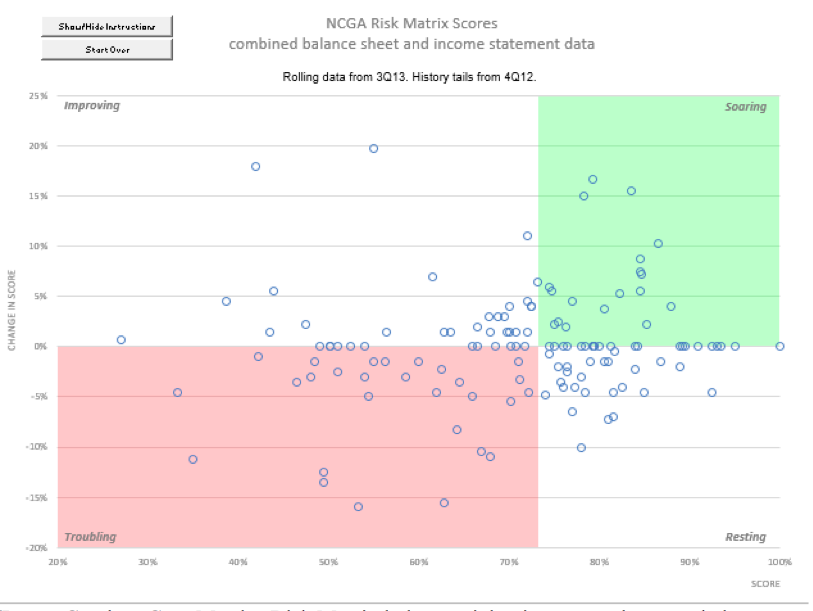
    We see this same dynamic at work with CoopMetrics, which is focused on peer benchmarking of financial data for social enterprises.

    CoopMetrics pulls data from accounting systems and automates the process of mapping very different financial statements to a common chart of accounts so that participating organizations can see their financial performance in context of their peer group. Again peer benchmarking makes better decisions possible.

    For example, at one point, CoopMetrics founder, Walden Swanson, was conducting a data dive with a peer group of produce managers from dozens of natural foods cooperatives from across the Northeast. To Swanson’s surprise, a general manager of one of the stores walked into the meeting.

    The GM pulled Swanson aside to let him know why he was there. His store’s produce department margins had been declining. He wanted to fire his produce manager, and he was there to find and recruit the best performing produce manager in the region.

    As the GM watched from the back of the room, it did not take long to discover that everyone’s produce department performance was down. The group grappled with the reasons why and concluded that there was a common cause; it was an El Niño weather year and rising produce prices had pushed everyone’s margins down.

    The store whose GM wanted to get rid of his produce manager was actually performing in the top quartile. As it turns out, he already had one of the highest performers! The problem was that without this kind of comparative benchmarking, it is impossible to really understand what is driving your overall performance.

    We expect the ecosystem for data tools that advance decision-making in the social sector to begin to evolve at a more rapid clip. Collaborative data approaches that enable peer benchmarking are an essential component to the data ecosystem.


  • The Most Interesting Things from Thursday’s Housing Forum at City Hall

    The Most Interesting Things from Thursday’s Housing Forum at City Hall

    From The Stranger

    Posted by on Mon, Feb 17, 2014 at 4:23 PM

    shutterstock_87467168.jpg

    Last week, Dominic urged you to attend a forum organized by the city council around affordable housing in Seattle. Why did he want you to go hang out at City Hall and watch PowerPoints? Because the affordability of housing, and how to better achieve it, is one of the most hotly debated topics in the city.And you know why: Because if you’re a renter, or a prospective home-buyer, and you make less than the median income (around $60,000 a year for a single-person household), you may have noticed recently that shelter is expensive as all hell, and only getting expensiver.

    But the things that really stood out most in my mind from the housing forum were not part of any PowerPoint. They were a couple of offhand comments by a consultant, Rick Jacobus:

    • First, he mentioned that data shows that mixed-income neighborhoods are good for everyone—both the higher- and lower-income people who live in them. Which is an important reminder for people who keep arguing that the only solution is to just have developers keep building whatever and wherever they want, without much restriction, and let the market take care of it—meaning let the centrally located, amenity-filled neighborhoods with expensive land prices house the rich, while the poor and middle-class are pushed out into outlying, less-accessible, transit-starved neighborhoods where land prices are cheap.

    I have a message for y’all market-solutions-only-forever people: Your city sounds terrible.

    • Second, someone asked Jacobus about the inherent conflict between affordable housing requirements and density. If you’re not a housing/land-use nerd, this is basically a fight between well-intentioned density activists, who say that adding more housing will drive prices down (they sometimes sound just like the market-will-solve-everything people I mentioned above), and well-intentioned affordable-housing activists, who say you should straight-up require developers to build some moderately-priced housing while they’re also building fancy-schmancy units for the rich. He answered carefully, saying that while studying Seattle’s housing issues, he heard that argument a lot. But, he continued, you don’t hear that argument anywhere else. In other cities, he said, people who fight for affordable housing requirements and people who fight for density are on the same side, and the developers use the fact that they’ll be paying for affordable housing as a way to sell density to wary residents.

    Seattle, it would seem that we keep having entirely the wrong conversation here.

    Way wonkier stuff coming soon, but for now, I leave you with one more important thing I learned: Eating a banh mi in the back of a conference room and wearing fleece don’t mix. (Crumbly sandwich + fleece = CRUMB MONSTER.) Hot tip, y’all! Don’t forget.

  • Seattle Incentive Zoning Study

    Seattle Incentive Zoning Study

    Incentive Zoning ReportBy Rick Jacobus and Joshua Abrams

    The Seattle City Council commissioned this study to assess the impact of their Incentive Zoning policy.  We compiled data about market rate housing production, affordable housing needs and the activity under Seattle’s Incentive Zoning Program in order to address a set of key questions relevant to potential changes to the IZ program.

    Download PDF File


    Presentation:

  • Shelterforce: Neighborhood Improvement Can Prevent Gentrification

    Shelterforce: Neighborhood Improvement Can Prevent Gentrification

    Alan Mallach’s blog post, “Hung Up on Gentrification? Don’t Be” seems to have struck a familiar nerve.

    Certainly, gentrification is one of the most vexing issues facing community development practitioners. Even where gentrification is only a distant threat (or hope, depending on your perspective) it looms large in any discussion of neighborhood change. And the way most people talk and think about it seems to create a black hole of self-doubt from which no realistic strategy for neighborhood improvement can escape.

    The paralyzing thinking goes like this: We want to improve lower-income neighborhoods to make them better places for the people who live there now but anything we do to make them better places will inevitably make people with more money want to live there and this will inevitably drive up rents and prices and displace the current residents, harming the people we set out to help (or, in many cases, harming the very people responsible for making the neighborhood better through years of hard work) and rewarding people who drop in at the last minute to displace them.

    Once you recognize this dynamic, it is very hard to talk yourself into wholeheartedly backing any kind of action. It seems wrong to leave distressed communities to rot but it also seems wrong to turn them around. Sadly, the most common response is to try to find strategies that improve things, but not too much. We feel okay about working toward improvement as long as we don’t really expect to succeed.

    Luckily, this paradox is built on a total misunderstanding of how neighborhood change actually happens.

    I suspect that what Alan dismisses as “social ownership” may actually be one key to overcoming this misunderstanding.

    People tend to talk as if all neighborhoods fell along a single continuum from worse to better. But, in reality, there is more than one kind of better. My experience has been that residents of low-income communities almost universally want their neighborhoods to be “cleaner” and “safer” and to have more stores even though they generally also recognize that those changes will eventually lead to higher rents. However, they generally really don’t want their neighborhoods to become “fancy”, “flashy”, “hip” or “trendy.”

    While it is common to worry about gentrification whenever rents rise, gentrification seems to happen most dramatically in neighborhoods where rents fall creating an opportunity for speculators to “flip” an area. While it sometimes happens that more moderate- and mixed-income, working-class neighborhoods become “hip”, it is far less common because middle-income families simply outbid the speculators and hipsters that form the leading wedge of gentrification. So for a lower-income community, “improvements” that make the place more attractive to slightly higher-income households may actually provide the most promising defense against gentrification.

    What is so promising about a program like the one Alan proposes, which encourages homebuyers to invest in lower-income neighborhoods along with incremental and sustained investment in things like commercial revitalization, is that these things won’t dramatically change the social character of a neighborhood overnight. And that means that the people who will choose to move in will be more likely to be people who are comfortable with the existing character of the neighborhood.

    This kind of gradual, sustained, and smaller-scale improvement leads to a broader but still contiguous income mix. By contrast, a large-scale investment in luxury lofts might also make the neighborhood more “mixed income” but the bi-polar income mix (high end and low end with no middle) is unsustainable; one group is bound to loose and we all know which one. Luckily the improvements that attract moderate-income working families and the businesses that serve them are very different than the ones that attract upper-income residents.

    Either kind of change will inevitably increase rents beyond some residents’ means. Either kind of change requires the kinds of counterbalancing public investment in preservation of long-term affordable housing that Alan references. But, a gradual influx of moderate-income homebuyers creates displacement at a scale that is closer to the scale of our affordable housing resources, while flipping a neighborhood to high end housing displaces people faster and makes the gap between market prices and what is affordable so great that it is simply ridiculous to discuss “affordable housing” as an appropriate response.

    When we see any kind of improvement as equivalent to gentrification we get stuck. We need a different definition of gentrification. My suggestion is that gentrification is “when your neighborhood becomes someone else’s neighborhood.”  That leaves room for “improvement” to mean “when your neighborhood becomes a better version of your neighborhood.”

  • Review: Is Inclusionary Zoning Inclusionary?

    Review: Is Inclusionary Zoning Inclusionary?

    Review of Is Inclusionary Zoning Inclusionary?, by Heather L. Schwartz, Liisa Ecola, Kristin J. Leuschner, Aaron Kofner. Rand Corporation, 2012.

    Long time advocates of inclusionary housing (often known as “inclusionary zoning”) will be relieved to learn that a new report from the Rand Corporation confirms that the housing produced by these policies is in fact “inclusionary,” meaning it creates or preserves affordable housing in areas of low poverty. It is easy to imagine big headlines if the research had found the opposite, but it is nonetheless valuable to have hard data confirming that social programs are achieving their intended effects.

    The Rand research team was led by Heather Schwartz, whose prior research on Montgomery County Maryland’s inclusionary housing compared the school performance of kids living in affordable housing in lower- and higher-poverty neighborhoods. In that study she found that low-income kids who moved to low-poverty schools were able to gradually catch up academically with their middle income peers while kids with stable affordable housing who stayed in high-poverty schools didn’t—even though Montgomery County spends more per student to support the kids in higher poverty schools.

    This new paper tackles the far less controversial question of whether homes that are produced by inclusionary policies are in fact located in low-poverty neighborhoods and/or near high-quality schools.

    Across the United States the majority of affordable housing units have been built in neighborhoods with high-poverty rates, but the Rand researchers found 75 percent of units produced through some sort of inclusionary ordinance were located in low-poverty neighborhoods. This is a big contrast to the 8 to 34 percent for other types of affordable housing. They looked at data from 11 cities and 15,500 affordable housing units. The average inclusionary unit in the study was located in a neighborhood where only 7 percent of households lived in poverty (half the national average). Only 2.5 percent of inclusionary homes were located in high-poverty neighborhoods.

    And as we would expect, access to higher income neighborhoods provided access to better schools. The inclusionary homes were located in the catchment areas of schools that had slightly lower poverty rates and slightly higher test scores than the other schools in these communities.

    While some might assume that an inclusionary housing program by its very nature would be expected to produce these results, the variation among cities that the report documents is ample evidence that we can’t take these results for granted—much depends on the details of the design and implementation of these programs, and policy makers and advocates have to pay attention to the data to ensure that the programs are doing what they were supposed to do.

    Unfortunately, this kind of data is shockingly hard to come by. The Rand researchers obviously had a difficult time compiling data on the location and characteristics of inclusionary homes, and they conclude that lack of funding for monitoring and collection of outcome data was “perhaps the greatest commonality among the 11 localities.” They rightly conclude that, given the value of the investment that goes into these homes, every inclusionary ordinance should create and fund some mechanism for ongoing data collection and evaluation.

  • Shelterforce: Best of Both Worlds

    Shelterforce: Best of Both Worlds


    Permanent affordability and asset building might seem at first blush to be contradictory goals for a low-income homeownership program, but new research says in fact they can be achieved together. By Rick Jacobus

    In the mid 1990s, the homeownership rate began to rise for the first time in decades. Social equity advocates were encouraged by the fact that, also for the first time, it appeared that ownership for lower income buyers and buyers of color was rising even faster. Policymakers in Washington cheered the fact that this change seemed to come from private mortgage market innovation rather than increased federal spending.

    Looking back, this all seems like a dream—or rather a nightmare. Rather than opening a door to economic opportunity for disadvantaged families, “innovative” mortgage products led to financial ruin for families and for our whole economy.

    The foreclosure crisis has led some policymakers to call for abandoning the goal of expanding access to homeownership. Certainly ownership has been oversold, and the current crisis demands a rethinking of housing policy including greater investment in affordable rental housing. But persistent and still-growing asset inequality (itself largely a product of discrimination in earlier generations of housing policy) remains a problem with very significant consequences, one that is unlikely to go away on its own. Any serious effort to overcome persistent asset inequality will require renewed efforts to overcome barriers to homeownership.

    Luckily, relaxing credit standards is not the only strategy for expanding access to homeownership. Decades of experimentation in state and local programs have shown that it is possible to invest in homeownership in smarter and more sustainable ways. A new research report from the Urban Institute suggests that local programs that provide significant purchase assistance to low-income buyers while preserving long-term affordability can offer a sustainable and scalable strategy for overcoming generational asset inequality.

    Homeownership and the Asset Gap

    Social policy in the United States has long focused on income-based measures of poverty and inequality. Since the late 1980s, however, there has been a growing attention to asset poverty and asset inequality and over the past few decades assets have been distributed more unevenly than income, and asset disparities have grown wider. According to a 2003 Census Bureau report, the average African-American family has net assets of only $9,750 while the average white family has $79,400.

    Most of this difference is home equity. The average homeowner has net assets of $235,000 while the average renter has only $5,000.

    This persistent and growing asset inequality is both a result and an ongoing cause of widespread inequality in access to homeownership. During the period following WWII, when federal programs made homeownership possible for the great majority of American families, these same programs were actively promoting racial discrimination in the housing market. By the mid 1960s, when overcoming discrimination became a key federal housing goal, federal programs were, ironically, no longer contributing to rising homeownership rates. The homeownership gap between white and minority households has not changed in decades and is projected to be higher in 2010 than it was in 1910.

    This historical ownership gap today drives continued inequality in access to homeownership—and by extension continued asset inequality. Renters who want to buy homes face multiple barriers including credit barriers, income barriers, and asset barriers. But recent studies have shown that asset barriers are the most widespread.

    Many young families overcome a lack of savings through gifts or loans from their parents or other family members. One-third of white first-time homebuyers receive financial support from a family member, but only 6 percent of African-American buyers receive family assistance, and those who do receive much lower levels of assistance. Families that didn’t benefit from asset appreciation through homeownership in prior generations therefore find that they are unable help the next generation access homeownership today. The high cost of housing and lack of family assets have largely taken the place of overt discrimination in preventing minority families from buying homes today—but the result is just the same.

    Overcoming the Wealth Barrier

    And yet, we do know how to overcome these barriers and make ownership safe and affordable for lower income families.

    A 2009 report by the U.S. Census Bureau estimated that 7 percent of current renters could safely afford to buy homes using standard mortgage products. They found that subsidizing mortgage rates by as much as 3 percentage points had virtually no effect on the number of renter families that could afford ownership and that offering loans with no downpayment requirements would increase that number by only 2 percentage points (to 9 percent). Providing purchase subsidies, on the other hand, had a more dramatic result. A subsidy of $10,000 (whether from a family member or a public program) would increase the number of renters who could qualify for ownership by 12 percentage points (to 19 percent).

    In light of this research, it is surprising to note that while we spend billions of dollars annually on programs to expand homeownership, only a very small fraction is currently invested in purchase subsidy programs. This is so even though purchase subsidies are currently the dominant strategy for supporting affordable rental housing.

    Programs that provide purchase assistance to bring the costs of homeownership down to an affordable level not only make ownership possible for lower-income buyers, they make it safer and more sustainable. Instead of borrowing more than they can afford to repay, qualified buyers borrow what their incomes can support, with the gap being covered not by a relative, but by a public or nonprofit agency.

    Many believe, however, that these programs are simply too expensive to offer a realistic alternative to mortgage product innovation as a path to expanded homeownership.

    A growing number of affordable homeownership programs address this concern by preserving long-term affordability so that a one-time public investment can make homeownership possible for one lower income family after another. These programs offer targeted assistance to buyers who would not be able to buy without such help and they preserve the affordability of assisted units so that many more households can ultimately benefit from the same initial investment. The growing stock of affordable homes in these programs offers a sustainable way to grow the overall rate of low-income and minority homeownership.

    These programs achieve this result by limiting the level of price appreciation available to owners. In exchange for significant public support at the time of purchase, they require owners to pass that benefit along to future lower income buyers by reselling at an affordable price or repaying the subsidy along with a share of any market price appreciation. Participating homeowners do build assets, but in an expanding market they earn less than unrestricted market-rate homeowners.

    Critics of this approach understandably question whether limiting a lower income buyer’s potential price appreciation defeats one of the key purposes of homeownership. If appreciation is limited, can affordable homeownership still offer a path out of generational asset poverty? If assisted homeowners can’t earn the same home equity gains that other owners enjoy, won’t they be trapped in affordable homes?

    Policymakers face what sometimes seems like a no-win decision: either they make grants that offer wealth-building but only to a lucky few or they preserve affordability but sacrifice the goal of reducing asset inequality.

    New Research

    Though many working in programs that balance both goals have long said this was a false choice, for the first time, there is real data that shows that long term affordability and significant asset-building can go hand in hand.

    NCB Capital Impact commissioned the Urban Institute to rigorously evaluate measurable outcomes for seven affordable homeownership programs that attempt to preserve long-term affordability. The Urban team analyzed data on home sales and subsequent resales through 2008 from three community land trusts, two limited-equity cooperatives, and two deed-restricted affordable housing programs.

    Each of the programs in the Urban study imposes some form of price restriction designed to keep homes affordable. And yet, these programs nonetheless had strong asset-building outcomes at the same time.

    Homeowners in these programs sold their homes after an average of three to six years. Their average total proceeds from sale ranged from $6,277 for a limited equity cooperative in Atlanta to $70,495 for owners in San Francisco’s Inclusionary Homeownership Program. In spite of the limitations, sellers received average appreciation ranging from $2,015 to $42,524.

    Because, for the most part, homeowners made small initial investments, this appreciation tended to represent a very high annual return on investment. For example, in Boulder, Colo., the average Thistle CLT homebuyer invested $6,080 in downpayment and closing costs at purchase. The Boulder sellers moved after an average of 3.4 years and earned an average of $8,107 in appreciation. These buyers earned the equivalent of 22 percent annual interest on the money that they invested to buy their affordable homes (“internal rate of return”). In the programs in the Urban study, participants’ internal rates of return ranged from 6.5 percent to 59.6 percent. In all but one case, they built more equity than they would have if they had placed their downpayment in an S&P 500 index fund or a 10-year Treasury Bond.

    But was it enough? The modest level of asset-building that these programs offer was enough to support sustained homeownership and to give households who originally couldn’t access the wider housing market the means to move on to buy a market-rate home.

    As part of their research, the Urban Institute surveyed households that had sold affordable homes in one of the programs. In the four programs that participated in the questionnaire, a significant majority of sellers went on to buy owner-occupied

    market-rate housing without any further public subsidy. Boulder had the highest rate, with 78 percent of sellers using their affordable unit as a stepping-stone to market-rate homeownership.

    The annual turnover rate for the programs studied was comparable to national rates for all owners, dispatching concerns that participants would be locked into their properties.

    Although assisted homeowners generally accumulated less home equity than buyers of unrestricted, market-rate homes, they also had significantly less risk. They were less likely to experience foreclosure than the average homebuyer—even though their average incomes are much lower (See Stewardship Works, SF #163). And they managed to sustain homeownership at a far higher rate. Several studies have found that roughly half of all low-income, first-time homebuyers revert to rental housing within five years. By contrast, fully 91 to 95 percent of homeowners in this study remained owners five years later, either continuing to occupy their affordable home or having acquired a market-rate home.

    During a time when the housing market fluctuated drastically, the prices in all seven of these programs were remarkably stable, as were the income groups that could afford them. The result was that, because the homes remained affordable, the programs could offer safe and sustainable ownership and asset-building opportunities to a second, third, or fourth generation of buyers, generally without investing any further public subsidy. The Urban study found, for example, that the City of San Francisco was saving roughly $25 million annually by preserving affordability rather than having to introduce a new subsidy each time these homes were resold.

    Affordable Ownership as an Asset-Building Strategy

    Because these affordable homeownership programs can help families build wealth faster than investing in stocks or bonds with less risk than traditional homeownership, they offer a promising strategy for overcoming asset inequality. Much of the attention in asset-building policy has focused on individual development accounts (IDAs), which provide matched savings as an incentive to help lower income families build assets. While IDA programs generally serve a slightly lower income population, and they offer a way to save for important goals other than homeownership (including education and small businesses), they are often promoted as offering a path to homeownership for low-income participants. And yet most IDA participants are unable to save enough to access homeownership. Most IDA programs limit savings to $6,000 to $10,000 and the average IDA saver accumulates only $1,500. By comparison, affordable homeownership programs, even those with long-term affordability controls, seem of offer a more reliable way for low-income families to save enough to make traditional homeownership safely attainable.

    Contrary to what many have thought, we do not have to choose between affordability and asset building. We can do both. By offering real equity to families who would otherwise remain renters, and providing a safer vehicle for them to attain—and retain—homeownership, affordable homeownership programs can provide a predictable avenue for asset building and economic advancement.


  • A Path to Homeownership

    A Path to Homeownership

    Building a More Sustainable Strategy for Expanding Homeownership

    A Path to Homeownership
    A Path to Homeownership

    Download PDF File
    Homeownership continues to provide real social and economic benefits and remains a high priority for most American families, but the United States is experiencing significant declines in the ownership rate for the first time in decades. What we need is greater availability of targeted purchase assistance programs that address wealth barriers to homeownership.


    Event Video:

    For more about this event, visit the Center for American Progress.