Category: Commercial Revitalization

  • Shelterforce: Neighborhood Improvement Can Prevent Gentrification

    Shelterforce: Neighborhood Improvement Can Prevent Gentrification

    Alan Mallach’s blog post, “Hung Up on Gentrification? Don’t Be” seems to have struck a familiar nerve.

    Certainly, gentrification is one of the most vexing issues facing community development practitioners. Even where gentrification is only a distant threat (or hope, depending on your perspective) it looms large in any discussion of neighborhood change. And the way most people talk and think about it seems to create a black hole of self-doubt from which no realistic strategy for neighborhood improvement can escape.

    The paralyzing thinking goes like this: We want to improve lower-income neighborhoods to make them better places for the people who live there now but anything we do to make them better places will inevitably make people with more money want to live there and this will inevitably drive up rents and prices and displace the current residents, harming the people we set out to help (or, in many cases, harming the very people responsible for making the neighborhood better through years of hard work) and rewarding people who drop in at the last minute to displace them.

    Once you recognize this dynamic, it is very hard to talk yourself into wholeheartedly backing any kind of action. It seems wrong to leave distressed communities to rot but it also seems wrong to turn them around. Sadly, the most common response is to try to find strategies that improve things, but not too much. We feel okay about working toward improvement as long as we don’t really expect to succeed.

    Luckily, this paradox is built on a total misunderstanding of how neighborhood change actually happens.

    I suspect that what Alan dismisses as “social ownership” may actually be one key to overcoming this misunderstanding.

    People tend to talk as if all neighborhoods fell along a single continuum from worse to better. But, in reality, there is more than one kind of better. My experience has been that residents of low-income communities almost universally want their neighborhoods to be “cleaner” and “safer” and to have more stores even though they generally also recognize that those changes will eventually lead to higher rents. However, they generally really don’t want their neighborhoods to become “fancy”, “flashy”, “hip” or “trendy.”

    While it is common to worry about gentrification whenever rents rise, gentrification seems to happen most dramatically in neighborhoods where rents fall creating an opportunity for speculators to “flip” an area. While it sometimes happens that more moderate- and mixed-income, working-class neighborhoods become “hip”, it is far less common because middle-income families simply outbid the speculators and hipsters that form the leading wedge of gentrification. So for a lower-income community, “improvements” that make the place more attractive to slightly higher-income households may actually provide the most promising defense against gentrification.

    What is so promising about a program like the one Alan proposes, which encourages homebuyers to invest in lower-income neighborhoods along with incremental and sustained investment in things like commercial revitalization, is that these things won’t dramatically change the social character of a neighborhood overnight. And that means that the people who will choose to move in will be more likely to be people who are comfortable with the existing character of the neighborhood.

    This kind of gradual, sustained, and smaller-scale improvement leads to a broader but still contiguous income mix. By contrast, a large-scale investment in luxury lofts might also make the neighborhood more “mixed income” but the bi-polar income mix (high end and low end with no middle) is unsustainable; one group is bound to loose and we all know which one. Luckily the improvements that attract moderate-income working families and the businesses that serve them are very different than the ones that attract upper-income residents.

    Either kind of change will inevitably increase rents beyond some residents’ means. Either kind of change requires the kinds of counterbalancing public investment in preservation of long-term affordable housing that Alan references. But, a gradual influx of moderate-income homebuyers creates displacement at a scale that is closer to the scale of our affordable housing resources, while flipping a neighborhood to high end housing displaces people faster and makes the gap between market prices and what is affordable so great that it is simply ridiculous to discuss “affordable housing” as an appropriate response.

    When we see any kind of improvement as equivalent to gentrification we get stuck. We need a different definition of gentrification. My suggestion is that gentrification is “when your neighborhood becomes someone else’s neighborhood.”  That leaves room for “improvement” to mean “when your neighborhood becomes a better version of your neighborhood.”
  • Brookings: Retail Trade as a Path to Neighborhood Revitalization

    Brookings: Retail Trade as a Path to Neighborhood Revitalization

    Contact About Resources Portfolio Home

    Picture 5.png

    Buy the book on Amazon.com
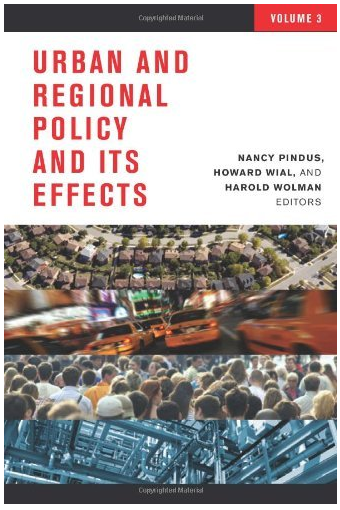
    Download the chapter: Retail Trade as a Path to Neighborhood Revitalization by Karen Chapple and Rick Jacobus

    Picture 10.png

    A condensed version of the chapter was also produced by UC Berkeley’s Center for Community Innovation.

    From the introduction:
    “Retail trade is a highly visible feature in a community, and is often a symbol of economic status. Terms like “upscale retail,” “strip mall,” or “big box store,” convey very different images of retail trade that are widely associated with economic prosperity, or the lack thereof. But, does retail trade really revitalize run down or neglected neighborhoods? And if so, what are the mechanisms at work, the successful strategies, and necessary conditions that lead to success? In “Retail Trade as a Route to Neighborhood Revitalization,” Karen Chapple and Rick Jacobus tackle these questions. They begin by defining the issues and expectations associated with retail development and neighborhood revitalization. The authors state that, from the perspective of residents, there are three types of neighborhood revitalization: more access to services and opportunities for low-income populations; changes from a low-income neighborhood to a mixed income neighborhood (due either to an influx of newcomers or increases in incomes for local residents); and gentrification that gradually replaces existing low-income residents with more affluent newcomers. Using a conceptual model, Chapple and Jacobus describe the relationship between retail development and neighborhood revitalization.

    Their review of the literature finds mixed evidence for the assumption that low-income neighborhoods are underserved, and limited formal evaluation of the effects of retail development, especially with respect to overall neighborhood improvement. The authors acknowledge the challenges to evaluating retail development programs, such as their small scale, the variety of actors involved, and limited neighborhood level capacity. In reviewing the evidence, Chapple and Jacobus examine three broad strategies to retail revitalization: public-led retail development, private-led retail development, and commercial corridor revitalization. Retail strategies variously target job creation, vacancy rates, private investment, public investment, tax revenues and property values, crime and safety, and community identity. In order to further explore the relationship between these retail development goals and neighborhood revitalization, Chapple and Jacobus provide a case study of the San Francisco Bay Area, analyzing the relationship between retail and neighborhood revitalization from 1990 to 2005 in a region with unusual increases in income inequality accompanied by significant revitalization. They find that the way the retail sector changes is closely related to how the neighborhood changes, with increases in middle income residents (rather than gentrification or other forms of change) most closely associated with retail revitalization.

    The paper concludes with the suggestion that any large-scale impacts of retail development on community economic health occur indirectly, such as through changes in internal and external perceptions of the neighborhood and, ultimately, changes in neighborhood residential composition. But, the authors note that existing studies of the effectiveness of neighborhood retail development strategies have not explored these broader impacts. Chapple and Jacobus also recommend further research to address how outcomes for the poor are tied to the specific character of neighborhood change. Such research might suggest specific retail development strategies that are most likely to benefit the poor and lead to stable mixed-income communities without contributing to displacement of the poor.”

  • SF Chronicle: Coffee Shops Perk Up Streets

    Coffee shops perk up streets; SAN FRANCISCO; Cafes revitalize neighborhoods by providing safe gathering places, drawing other businesses

    Marisa Lagos, Chronicle Staff Writer
    The San Francisco Chronicle (California)
    October 25, 2008

    Neighborhoods like North Beach and Noe Valley are teeming with coffee shops, but head south and you’re likely to find people clamoring for a cafe.

    In recent years, these businesses have become a key part of community efforts to revitalize commercial strips, arguably the most visible and telling element of any neighborhood. Coffee shops offer a safe, warm gathering place for neighbors, bring foot traffic to areas that need it, and tend to reflect the flavor of a community.

    Sometimes they also lead to some unexpected benefits. In the Bayview, for example, Javalencia coffee shop owner Servio Gomez parlayed the success of his Third Street business – and its open mike nights – into an adjacent gallery, which focuses on local artists. Mama Art Cafe in the Excelsior district also showcases local artists and musicians, and often opens its door for community meetings. And at Joe Leland cafe in Visitacion Valley, people stop by just to chat with owner Russel Morine, whose business is filled with posters for community events.

    “There wasn’t a cafe on Mission Street in the Excelsior when I first became supervisor in 2001,” said Supervisor Gerardo Sandoval, adding that there are now three in the area. “It was one of the ideas that always came up when you sat down with a group and said, ‘What would you like to see happen to the street?’ I think that reflects a need that people have for community, and a space where they can come together and relax.”

    Draw for other businesses
    That’s exactly what Portola district neighbors have been asking for, said longtime resident Irene Crescio.

    “We’ve been trying to get a coffee shop on San Bruno Avenue for a good six, seven years,” she said. “Once we get a business like that in, it will draw other businesses.”

    Cafes can help draw other businesses to an area previously seen as unsafe or untenable, agreed Rick Jacobus, a retail revitalization consultant who has helped efforts in the Excelsior and Portola districts.

    “The presence or absence of different businesses telegraphs the success of a neighborhood,” he said. “A retail area is a neighborhood’s front door. It’s the face they present to the outside world. If you have a coffee shop, it sends a message about what kind of neighborhood you have. … It seems like it’s successful, safe and desirable.”

    Later hours
    They also make nighttime businesses, such as restaurants, more likely to move in, he said.

    “Cafes can have longer hours than other businesses,” he said. “In the Excelsior, people wanted the commercial district to feel like a safe place, but it felt closed up at night. You can’t just open up one restaurant and expect it to survive, but a coffee shop can stay open later and bring some eyes to the street.”

    That’s exactly what Javalencia and Art94124 have done since opening this year on Third Street in the Bayview, said India Basin resident Kristine Ennea. That commercial corridor lost a number of businesses during the drawn-out construction of the Third Street Light Rail.

    “It was sorely needed,” Ennea said of the cafe. “In the Bayview, probably more than any other neighborhood, there’s a perception of danger. If you have businesses clustered together, they start drawing in customers and people feel safe.”

    Gentrification fears
    The fear of gentrification is a real one, but neighbors say coffee shops, if done right, can actually bring together different groups that exist within neighborhoods. This is particularly the case when they are owned by community members, such as Morine, who grew up in the Bayview and has lived in Visitacion Valley for 12 years.

    “It wasn’t my goal to own a coffee shop,” said Morine, who recently completed his master’s degree in city planning from UC Berkeley. “But a cafe was the one thing the community wanted that we didn’t have that was doable. It’s a place for people to meet, sit and talk – and it’s there every day.”

    All income strata
    Many communities list other businesses, including grocery stores and bookstores, right up there with cafes when they are trying to revitalize commercial corridors. But coffee shops are often more likely to materialize because they are fairly simple retail businesses, Morine said.

    And, regardless of your ethnic or socioeconomic heritage, you can usually find something you like there, said Sandoval.

    “There are often questions about who will pay $3 for a cup of coffee, that it won’t be a lot of working-class people,” he said. “But surprisingly, that’s not the case – if you go into these cafes, you will find people from all economic stratums reading newspapers, using the Internet or talking to friends. People want a place to congregate and socialize.”

    Copyright 2008 San Francisco Chronicle All Rights Reserved

  • Grocery Store Attraction Strategies

    Grocery Store Attraction Strategies

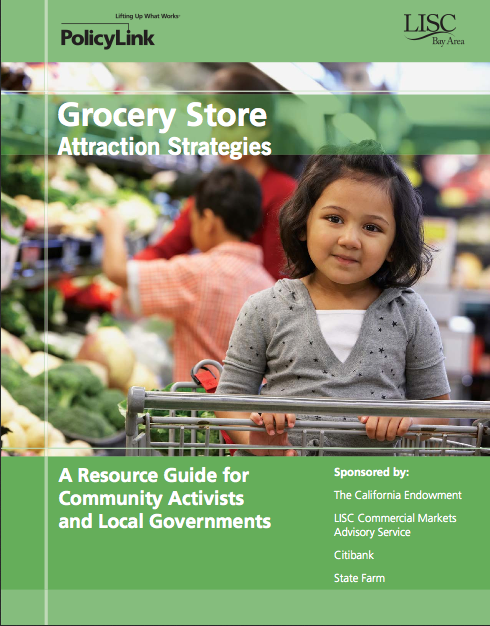
    Grocery Store Attracton StrategiesA Resource Guide for Community Activists and Local Governments

    By Rick Jacobus and Maureen Hickey

    Download PDF File

    This report was commissioned by Bay Area LISC and PolicyLink with sponsorship from the California Endowment, LISC’s Commercial Markets Advisory Service, State Farm Insurance, and CitiBank.  The report provides an overview of the process that community activists have used to attract new fresh food retailers into disinvested urban communities.


  • Economic Development and Health Toolkit

    Economic Development and Health Toolkit

    Economic Development for Public Health Advocates

    PHI Web_med.png

    Now Online at ChangeLab Solutions

    Download PDF File

    This toolkit developed for the Public Health Institute’s Land Use and Health Program is designed to provide an overview of Economic Development and Redevelopment issues for health advocates seeking new food stores in low income communities.

    TABLE OF CONTENTS:
    Section I: Introduction to Economic Development, Redevelopment, and Health

    1. Introduction to this Toolkit
    2. The Connection Between Economic Development and Health
    3. Why Do So Many Communities Lack Access to Healthy Food?
    4. Developing a Strategy

    Section II: Economic Development

    5. What is Community Economic Development?
    6. Types of Community Economic Development Programs
    7. Economic Development Institutions
    8. Financing Sources

    Section III: Redevelopment

    9. Overview of Redevelopment Law
    10. Legal Requirements for Redevelopment
    11. Introduction to Tax Increment Financing
    12. Introduction to Eminent Domain
    13. Support for Economic Development Projects
    14. Final Points

    Section IV: Strategies for Participation

    15. Building Community Support
    16. Data Collection
    17. Model Redevelopment Resolution
    18. Communicating with Public Officials

    Section V: Appendices

    Appendix 1: Sample Market Research Consultant Request for Proposals
    Appendix 2: Redevelopment Agency Model Resolution
    Appendix 3: Resources

  • Grocery Store Attraction Symposium

    Grocery Store Attraction Symposium

    Sponsored by PolicyLink and Bay Area LISC

    This one-day workshop/discussion brought together local government staff, community advocates, economic development practitioners, and others who are working to bring healthy food retailers to underserved, low-income, urban, or rural communities.

    The event provided an overview of the many obstacles that make new store development challenging and highlighted some of the emerging best practices that have made new stores possible in previously underserved areas. The emphasis of the event was on discussion of the real world challenges that participants are facing and potential strategies to overcome them.

    Companion Report:

    Grocery Store Attracton Strategies

  • Commercial Revitalization Planning Guide

    Commercial Revitalization Planning Guide

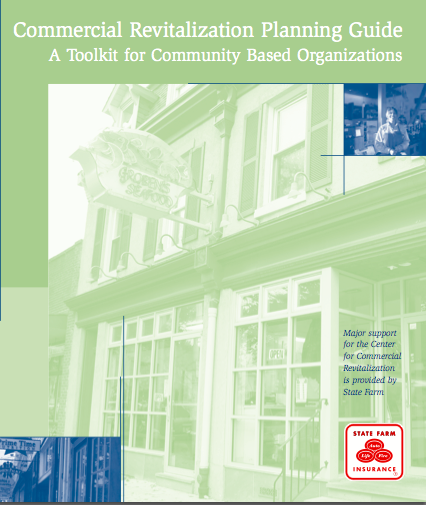
    Commercial District Revitalization Planning Guide
    Commercial District Revitalization Planning Guide

    By: Rick Jacobus and Maureen Hickey

    This hands on guidebook is filled with detailed direction that will provide practitioners with a starting point for organizing comprehensive commercial district revitalization efforts. It takes the reader through each stage of revitalization from planning, research, and visioning to understanding the potential of the community, analyzing the business mix, marketing the assets, and implementing the work plan. The planning guide also provides a set of practical tools to assist in implementation.

    Table of Contents:
    Forward
    Urban Commercial Revitalization Programs
    Planning For Revitalization
    Identifying and Involving Stakeholders
    Developing a Community-Based Vision
    Compiling Building and Business Inventories
    Understanding Market Data
    Using Surveys and Interviews to Collect Local Market Data
    Assessing Crime and Community Safety
    Developing Business Attraction Goals
    Evaluate Streetscape Conditions
    Branding the District Identity
    Defining an Implementation Strategy
    Measuring Impact

    Appendix A: Hiring a Market Analysis Consultant
    Appendix B: Resources
    References
    Acknowledgements
    Download a PDF of the book

  • Joint Venture Guide

    Joint Venture Guide

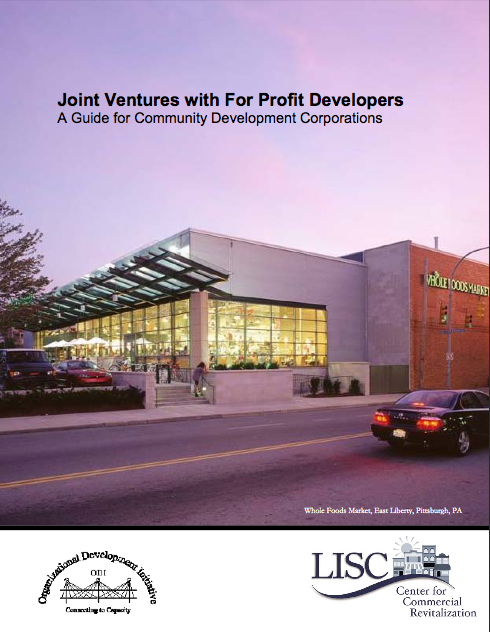
    Joint Ventures GuideJoint Ventures with For-Profit Developers. A Guide for Community Development Corporations

    Written by Greg Maher, Rick Jacobus, Maegan Winning and Judy Turnock.

    This guide is designed to assist CDCs in becoming educated consumers as they think about, plan and become partners in joint ventures with for-profit developers.

    Joint ventures between a community development corporation (“CDC”) and a for-profit partner present tremendous opportunities for a CDC to build its skills and complete projects that are larger in scale and/or beyond its core competencies. However, there are a host of business issues raised by the prospect of a CDC co-owning or working closely with a for-profit on a project. Many issues need to be carefully negotiated for the CDC to protect its financial integrity and credibility. Based on Greg Maher’s 2005 memo, this guide is structured to assist CDCs in becoming educated consumers as they think about, plan and become partners in joint ventures with for-profit developers.

    Download PDF file

  • San Francisco’s Neighborhood Marketplace Initiative

    Mayor Newsom Announces Neighborhood Marketplace Initiative
    Unique program targets public, private resources
    to strengthen neighborhood business districts

    May 23, 2005

    SAN FRANCISCO – Speaking at a national conference on urban commercial district revitalization held in San Francisco today, Mayor Newsom announced a new program to bolster neighborhood business districts – the Neighborhood Marketplace Initiative. The initiative is a public-private partnership between the City of San Francisco, the nonprofit Local Initiatives Support Corporation (LISC), and private corporate and philanthropic donors. Coordinated by LISC and the City, the Neighborhood Marketplace Initiative (NMI) represents a major step forward in efforts to strengthen the city’s neighborhood business districts.

    The City and LISC are backing the Neighborhood Marketplace Initiative to improve job creation, investment and the physical landscapes in San Francisco’s neighborhoods. Piloted recently in the city’s Excelsior district with tremendous results and modeled on similar LISC-supported programs around the country, the Neighborhood Marketplace Initiative brings together business, resident, and other civic leaders in selected neighborhoods to develop and implement business district improvement strategies. Across the country similar programs have proven effective at reducing storefront vacancies, bringing in new businesses and jobs, and stimulating community involvement.

    “What makes this program unique, and why we are excited about it,” said Mayor Newsom, “is that we have city departments, LISC, and local funders coordinating work and dollars to assist our neighborhood business districts — and to assist the districts based upon what the residents and merchants say they need and want. It is a public-private partnership that is do-able and proven successful. It is exactly the kind of collaborative, targeted approach we need to help our neighborhoods and local businesses.”

    Under the Neighborhood Marketplace Initiative, the City and LISC jointly plan to invest approximately $500,000 annually to support neighborhoods selected for the program. Private funders play a pivotal role; approximately half of this investment is provided through donations to LISC from the State Farm Insurance Companies and the Evelyn & Walter Haas, Jr. Fund, among other funders. In addition, LISC is targeting an additional $25 million in flexible loan dollars ($10 million) and other financing ($15 million) for viable and desired development projects in neighborhoods selected to participate in the initiative.

    Five neighborhoods have been selected to receive initiative assistance as part of the program’s launch. The Excelsior and Visitacion Valley will receive assistance in implementing comprehensive commercial corridor plans while Third Street in the Bayview, San Bruno Avenue in the Portola neighborhood, and Ocean Avenue in the OMI (Ocean-Merced-Ingelside) neighborhood will all receive assistance in developing a comprehensive strategy and beginning implementation. The targeted neighborhoods will benefit from coordinated services from several city agencies. For example, some of the neighborhoods will receive priority for façade improvement grants through SF Shines, a program of the Mayor’s Office of Community Development as well as support from the Mayor’s office of Economic and Workforce Development in working with property owners, developers and retailers to fill vacant retail properties.

    Some of the targeted neighborhoods will also receive help in forming community benefit districts (CBD). Similar to a Business Improvement District, a CBD is formed when property owners in a proposed district voluntarily agree to a special assessment in addition to their regular property taxes, in order to finance capital improvements and services over and above those already provided by the City.

    “Because the City, LISC and other funders are working together to support these neighborhoods, we are not only using existing resources more effectively but we hope to engage more local corporate and philanthropic institutions in helping our neighborhoods”, said Stephanie Forbes, Director of LISC’s Bay Area program. “With this partnership, we now have the infrastructure for a new era of neighborhood change based upon residents and merchants working together on the ground, and the local funders and the City working together to support their visions. We can’t afford to work separately anymore.”

    The Mayor’s announcement was made at the opening session of a conference bringing together more than 400 neighborhood revitalization practitioners from around the country. Urban Forum 2005, the third such conference hosted by LISC’s Center for Commercial Revitalization, will include several workshops and presentations, with a special focus on successful efforts to help communities revitalize commercial corridors. The conference is being held today and tomorrow at the Bill Graham Civic Auditorium.

    LISC is a 25 year-old national nonprofit community development support organization that provides program models, policy analysis, training, technical assistance and financing to help community-based organizations working on behalf of our nation’s lower income families and neighborhoods. LISC works in 33 urban areas around the country and operates a rural program in 66 rural areas. LISC is the largest nonprofit community development financial institution in the country. Bay Area LISC has supported the region’s affordable housing and community development work since 1981.
    ####

  • Commercial Development Training Program

    Commercial Development Training Program

    I developed this series of day long and multi-day workshops for the Local Initiatives Support Corporation’s national Center for Commercial Revitalization to help community development corporations and local governments understand the unique challenges associated with neighborhood retail development. I delivered training courses in communities around the country including: Philadelphia, Providence, Indianapolis, San Francisco, Toledo, Jacksonville, San Diego, Seattle, Miami and Cincinnati.

    Workshop topics include:

    Developing a Neighborhood Retail Strategy (1 day)
    Commercial District Revitalization 101 (2.5 days)
    Introduction to Commercial Real Estate Development (2 days)
    Developing a Retail Leasing Strategy (1 day)
    Joint Ventures with Private Developers (1 day)
    Financing Commercial Real Estate Projects (1 day)
    Negotiating Commercial Leases (1 day)
    Evaluating Commercial Tenants (1/2 day)
    Commercial Property and Asset Management (1 day)
    Overview of Commercial Real Estate Development (2.5 hours)
    Overview of Commercial District Revitalization (2.5 hours)

    Download flyer with detailed course descriptions