Category: Data

  • Pay for Success: Overcoming Information Asymmetry

    Pay for Success: Overcoming Information Asymmetry

    June 2, 2014   |  by Rick Jacobus, Director of Strategy and F.B. Heron Foundation Joint Practice Fellow at CoopMetrics

    If you read much of the recent flurry of writing about Pay for Success, you will notice a regular pattern where authors acknowledge that widespread implementation will require “better data” and then quickly change the subject. Surely better data is on the way. We live in an age where it is easy to take this kind of inexorable progress for granted, but given the level of enthusiasm for Pay for Success, it is worth considering what it will realistically cost to get good enough data.

    Certainly the whole potential of Pay for Success rests on data. In order to offer strong financial incentives for success, a government agency must be able to know that their private partner has succeeded. And measuring the “success” of a social program is notoriously hard. We all know it when we see it, but it is not simple to write out a clear and unchanging definition for any given program. A youth employment program cannot simply be judged by the number of youth who get jobs—we need to say something about the quality of those jobs, the level of challenge facing the youth who enter the program, the local economy’s strength, etc.

    This is an example of what economists call information asymmetry. George Akerlof, who won the Nobel Prize for his work on information asymmetry, wrote a paper in 1970 about the market for used cars. Some used cars are in great shape and others are what Dr. Akerlof called “lemons:” they look fine but have been poorly maintained or have other hidden problems. Sellers know which kind of car they have, but buyers cannot immediately tell which is which. Sellers of above-average cars generally have to settle for average price, and buyers have to risk paying average price for a below-average car. A key point is that buyers can partially overcome this asymmetry by investing in information about a potential car; they can hire a mechanic to examine it. But there is also a limit—a simple inspection might weed out the worst cars, but the difference in value between an average and an above-average car may not be enough to justify a more complete inspection.

    Information asymmetry has historically been one reason that we have created nonprofit organizations. Take childcare: A childcare provider knows whether they are providing quality care or not, but it is difficult for parents to tell the difference. It would be very easy for an unscrupulous operator to boost profits by cutting important corners. It is not that they have more incentive to cut corners than someone who makes toothpaste, but because the parents who pay are not the day-to-day users of the service, it is easier to hide the cost-cutting. Organizing a child care center as a not-for-profit organization does not overcome the information asymmetry, but it does accommodate it by reassuring parents that at least the center does not have any incentive to provide low-quality care.

    Like parents, philanthropic donors are not present daily to see whether an organization is doing everything it can to make the most difference. Instead, they have to settle for knowing that the groups to which they give are trying to make a difference and do not have a profit motive to cut corners. The downside of this approach is that donors, like used car buyers, may sometimes have to accept average performance.

    Rather than accommodating information asymmetry, Pay for Success tries to overcome it. This is like pushing water uphill—it can be done, but you have to invest energy to do it. The very idea of Pay for Success requires a significant investment in information. In place of a government agency directly funding a social service agency and accepting average performance, a social impact bond (SIB) requires several layers of intermediaries and generally two levels of professional evaluation: an evaluator who works directly with the program to measure impact and an independent assessor who reviews the data on behalf of the government agency.

    McKinsey & Company developed a proforma to analyze the financial benefits of a hypothetical SIB focused on juvenile justice [1]. They found that even if an SIB-backed intervention produced significant savings for government agencies, the SIB structure was far more costly than directly funding the same services. In their model, a $14.4 million direct investment in preventive services would save the government $14.4 million in corrections costs over a period of about eight years. A successful SIB that funded the same $14.4 million program would incur an additional $5.7 million in research and administrative costs, success fees, and investor profits, and McKinsey & Company estimates that it would therefore take 12 rather than eight years before the public savings justified the increased cost.

    This extra cost sets the bar pretty high for the performance gains that the SIB must deliver. Information technology improvements will continue to make investment to overcome information asymmetry practical in more and more situations, but when the cost of collecting data is taken into account, the social problems that lend themselves to an SIB will be harder to find than they would be if perfect information were free. Once we have found them all, there will still be many important social problems that are worthy of public investment.

    If we want to confront some of our most complex social challenges, we have to come to terms with the reality that a significant level of information asymmetry is a fact of life and we cannot wish it away by calling for better data. For some social problems, sizable investment in information may make it practical to offer financial incentives to the best-performing programs. For the rest, we do not have to give up on using data to drive improved performance, but sometimes it might be more cost-effective to focus on raising the performance of the average program instead of providing financial incentives for above-average performance.


    [1] McKinsey & Company. (2012). From potential to action: Bringing social impact bonds to the US. Retrieved from http://www.rockefellerfoundation.org/news/publications/from-potential-action-bringing-social

  • Salesforce Foundation: 3 ways to make the case for Tech Funding

    Salesforce Foundation: 3 ways to make the case for Tech Funding

    From the Salesforce.com Foundation Blog

    For profit businesses are routinely able to raise significant capital in the expectation that a new technology will create higher profits over the long term. Nonprofits, by definition, can’t make this same promise and, therefore, find it much harder to raise the kind of money necessary to invest in transformative technology.

    But the technology itself holds the same promise to totally transform everything that nonprofits do – it is just taking us much longer to realize that promise. We know how to sell donors on delivering services and even changing policy but we have always had a harder time convincing people to fund institutional capacity and technology is essentially a new kind of organizational capacity that is now competing with everything else for scarce resources.

    When we are raising money for tech, we need to make the case that the investment will pay for itself in one of three ways: either by lowering costs, by raising revenue or by increasing our social impact.  Sometimes, our projects will offer all three benefits.

    1. Lower Costs

    In many ways, nonprofits are no different from other businesses: many technology investments will simply allow us to do what we do for less money over time.  While this increased efficiency can make organizations more sustainable, this category may be the hardest to get donors excited about because it may not directly translate to observable differences in our services.

    Making the case for this kind of investment involves calculating a payback period – the period of time over which an investment in technology will pay for itself. Be careful not to assume that these savings last forever, though.  Every technology has a useful life and more innovative technologies often become outdated quickly.

    2. Increase Revenue

    Technology that helps organizations build stronger connections or more effectively communicate with their donors can drive real increases in fundraising.  Similarly, technology that helps organizations do a better job of capturing the social impact that they are having (whether through formal measurement and statistical metrics or simply human stories) can increase revenues enough to easily justify their costs.

    Making the case for this kind of investment is also just a matter of calculating the payback period but now this is much harder to do because it is harder to predict the impact on revenue. So instead, turn the math around and calculate the level of annual increase in fundraising that would be necessary to ‘break even’ on the investment over the expected life of the technology.  Help funders see how easy it would be to exceed that level.

    3. Multiply Impact

    While there are plenty of examples where technology investment leads to long term cost savings or revenue improvement for nonprofits, we can’t always expect that.  In so many other situations we see the potential of technology to make a difference in our work but we know that the technology will increase our ongoing costs not lower it.  Too often we back away from these opportunities – we try to do more with less when we should be doing more with more!

    A 2010 survey found that, while 95% of nonprofit leaders consider IT to be critical to their finance and accounting activities, less than half said IT was critical to their service delivery and programs and only 26% said it was critical to their public education and advocacy.

    Making the case for investments that increase impact is much harder. Just as start up entrepreneurs have to convince investors that a given technology is likely to create radical new business opportunities, social entrepreneurs have to convince donors that new technologies have the potential to radically transform our social change work.  But because we are not likely to find one ‘Angel Investor” who will make a very large bet on the technology, we have to also show how relatively modest incremental investment can gradually unlock the potential of the technology and create change that is more than simply incremental.

    One of the reservations that funders have with funding capacity building of any kind is that these kinds of investments can be a black box – when money is being spent on something other than service delivery it is harder to know whether it is being spent on the right things.  It we want to avoid the nonprofit starvation cycle we have to shine light into that black box and help funders to see the inner workings so that they can understand why the specific technology investments we are pursing can help us do more of the good that they are looking to us to do in the world.

  • Markets for Good: Peer Benchmarking for Better Decisions

    Markets for Good: Peer Benchmarking for Better Decisions

    Originally posted at Markets for Good

    It is becoming an article of faith that more data helps people make better decisions. But not all data is created equal. To be meaningful, data needs to be seen in context. This is particularly true of data about the performance of nonprofits or other social enterprises. Funders and government agencies routinely compel social programs to track and report financial and social outcomes but, too often, are not in a strong position to know what to make of the resulting numbers.

    One way to give performance data context, and ultimately meaning, is through peer benchmarking. A growing number of experiments are aggregating data across networks of similar social programs or enterprises to construct peer benchmarks.

    One example of this emerging strategy is Capital Impact Partner’s HomeKeeper project. HomeKeeper is a Salesforce.com application that helps nonprofits manage affordable homeownership programs. Capital Impact aggregates data from the 60 organizations using the system and automatically generates social impact reports that help each of the participating programs better understand their social performance.

    By enabling programs to see how their performance compares to a national peer group, HomeKeeper makes the data far more salient and actionable.

    For example, most affordable housing programs seek to ensure that families spend no more than one-third of their income for their housing costs. But most programs make exceptions to this rule for a number of circumstances such as when a family has been successfully paying more and their cost burden will be decreased in their new home. These kinds of exceptions are necessary and appropriate but one of the first pilot HomeKeeper users was concerned to find that nearly 20% of their buyers were paying more than 33% of their income.

    Without context it is hard to know whether this 20% represents a serious problem or not. It was tempting to jump to the conclusion that this program was failing to ensure that the buyers of their ‘affordable’ housing could actually afford their new homes. But, it turned out that across thousands of transactions in dozens of programs, about 27% of buyers were paying more than the 33% standard. As housing costs have risen, lower-income families in high cost markets have become accustomed to paying what was historically a high share of their income for housing – the exception had become more of the rule.

    And it turns out that these programs have been successful in serving these buyers with few or no loan defaults which suggests that a program with 20% cost burdened buyers may not have much cause for concern. Without the context provided by peer benchmarking, we could well have drawn the opposite conclusion.

    We see this same dynamic at work with CoopMetrics, which is focused on peer benchmarking of financial data for social enterprises.

    CoopMetrics pulls data from accounting systems and automates the process of mapping very different financial statements to a common chart of accounts so that participating organizations can see their financial performance in context of their peer group. Again peer benchmarking makes better decisions possible.

    For example, at one point, CoopMetrics founder, Walden Swanson, was conducting a data dive with a peer group of produce managers from dozens of natural foods cooperatives from across the Northeast. To Swanson’s surprise, a general manager of one of the stores walked into the meeting.

    The GM pulled Swanson aside to let him know why he was there. His store’s produce department margins had been declining. He wanted to fire his produce manager, and he was there to find and recruit the best performing produce manager in the region.

    As the GM watched from the back of the room, it did not take long to discover that everyone’s produce department performance was down. The group grappled with the reasons why and concluded that there was a common cause; it was an El Niño weather year and rising produce prices had pushed everyone’s margins down.

    The store whose GM wanted to get rid of his produce manager was actually performing in the top quartile. As it turns out, he already had one of the highest performers! The problem was that without this kind of comparative benchmarking, it is impossible to really understand what is driving your overall performance.

    We expect the ecosystem for data tools that advance decision-making in the social sector to begin to evolve at a more rapid clip. Collaborative data approaches that enable peer benchmarking are an essential component to the data ecosystem.


  • Seattle Incentive Zoning Study

    Seattle Incentive Zoning Study

    Incentive Zoning ReportBy Rick Jacobus and Joshua Abrams

    The Seattle City Council commissioned this study to assess the impact of their Incentive Zoning policy.  We compiled data about market rate housing production, affordable housing needs and the activity under Seattle’s Incentive Zoning Program in order to address a set of key questions relevant to potential changes to the IZ program.

    Download PDF File


    Presentation:

  • Economic Development and Health Toolkit

    Economic Development and Health Toolkit

    Economic Development for Public Health Advocates

    PHI Web_med.png

    Now Online at ChangeLab Solutions

    Download PDF File

    This toolkit developed for the Public Health Institute’s Land Use and Health Program is designed to provide an overview of Economic Development and Redevelopment issues for health advocates seeking new food stores in low income communities.

    TABLE OF CONTENTS:
    Section I: Introduction to Economic Development, Redevelopment, and Health

    1. Introduction to this Toolkit
    2. The Connection Between Economic Development and Health
    3. Why Do So Many Communities Lack Access to Healthy Food?
    4. Developing a Strategy

    Section II: Economic Development

    5. What is Community Economic Development?
    6. Types of Community Economic Development Programs
    7. Economic Development Institutions
    8. Financing Sources

    Section III: Redevelopment

    9. Overview of Redevelopment Law
    10. Legal Requirements for Redevelopment
    11. Introduction to Tax Increment Financing
    12. Introduction to Eminent Domain
    13. Support for Economic Development Projects
    14. Final Points

    Section IV: Strategies for Participation

    15. Building Community Support
    16. Data Collection
    17. Model Redevelopment Resolution
    18. Communicating with Public Officials

    Section V: Appendices

    Appendix 1: Sample Market Research Consultant Request for Proposals
    Appendix 2: Redevelopment Agency Model Resolution
    Appendix 3: Resources

  • Resale Formula Comparison Tool

    Resale Formula Comparison Tool

    Resale Formula Tool
    Resale Formula Tool

    Click here to launch the application

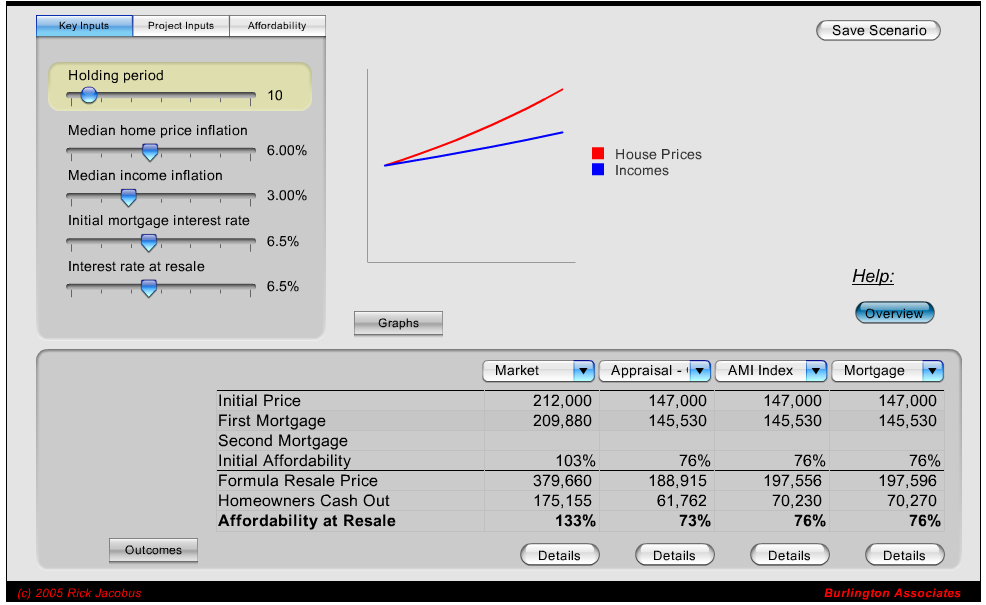
    This general purpose educational tool was designed to help community leaders understand the relative performance of different limited equity resale formulas. So much of what sets one model apart from the other is dependant on the assumptions you make about interest rates, home price inflation and income growth. This tool allows a side-by-side comparison between several models, and allows you to change these input assumptions and immediately see changes in the relative performance of each of the models in terms of both ongoing affordability and equity building for homeowners. The tool also allows you to look up historical data on home prices and median incomes for every metropolitan area in the country in order to get a better feel for what appropriate assumptions might be going forward.

    The tool compares several of the most common resale formulas including a basic AMI index, an appraisal based formula, a mortgage based formula and a shared equity loan model.

    The tool is intended to help policy makers to evaluate questions like:
    · When housing costs are rising rapidly, which approach preserves affordability best?
    · Which approach provides the greatest asset building opportunity in the face of rising interest rates?
    · If incomes grow more slowly than we expect, which approaches will be most impacted?

    You can make the analysis more relevant to your local conditions by customizing a number of background assumptions like cost of production for a new affordable unit, the level of subsidy available, and the monthly housing costs that homeowners will face.

  • Inclusinary Housing in California

    Inclusinary Housing in California

    Inclusionary Housing ReportWritten By Rick Jacobus and Maureen Hickey.

    Download PDF File

    Affordable By Choice:Trends in California Inclusionary Housing Programs was commissioned by the Nonprofit Housing Association of Northern California, The California Coalition for Rural Housing, The San Diego Housing Federation and the Sacramento Housing Alliance. The report details the findings of a statewide survey of local government agencies that have adopted inclusionary housing policies. Key findings include:

    * Nearly one-third of California jurisdictions have inclusionary programs
    * More then 80,000 Californians have housing through inclusionary programs
    * Most inclusionary housing in integrated within market rate developments
    * Inclusionary housing provides shelter for those most in need
    * Lower-income households are best served through partnerships


  • Beyond Lender Bias: The Struggle for Capital in a Networked Economy

    Beyond Lender Bias: The Struggle for Capital in a Networked Economy

    Rate at which Oakland There are real neighborhood differences in the rate at which home mortgages were resold on the secondary market.
    There are real neighborhood differences in the rate at which home mortgages were resold on the secondary market.

    There is no doubt that information technology has brought about huge changes in world financial markets. Markets which used to be largely isolated are now inextricably interconnected by a real time network of transactions in which, generally, capital flows instantly to the highest bidder regardless of the location of that bidder on the globe. We might expect this trend, which Richard O’Brian calls this “the end of geography,” to be good news for low-income communities. One could conclude that the development of an integrated and standardized financial network, by reducing the role of potentially biased individual lenders, could reduce racial and income discrimination and move the economy toward a situation where capital is allocated based entirely on the real value which various sectors contribute. And yet low-income urban communities in America and elsewhere appear to be experiencing increasing capital shortages.

    This paper identifies an emerging structural logic of the financial system under which investment decisions are made by a network that relies on previous transactions as the main source for information about credit quality. The home mortgage market in the United States is examined as a specific case of this more general global financial market transformation. Data relating to the secondary market for single family home mortgages in the Oakland, CA metropolitan area is employed to provide empirical support for the argument that the emerging financial network itself has distinct geographic preferences which place low-income and minority neighborhoods at a systematic disadvantage in the competition for capital.

    Download the PDF